
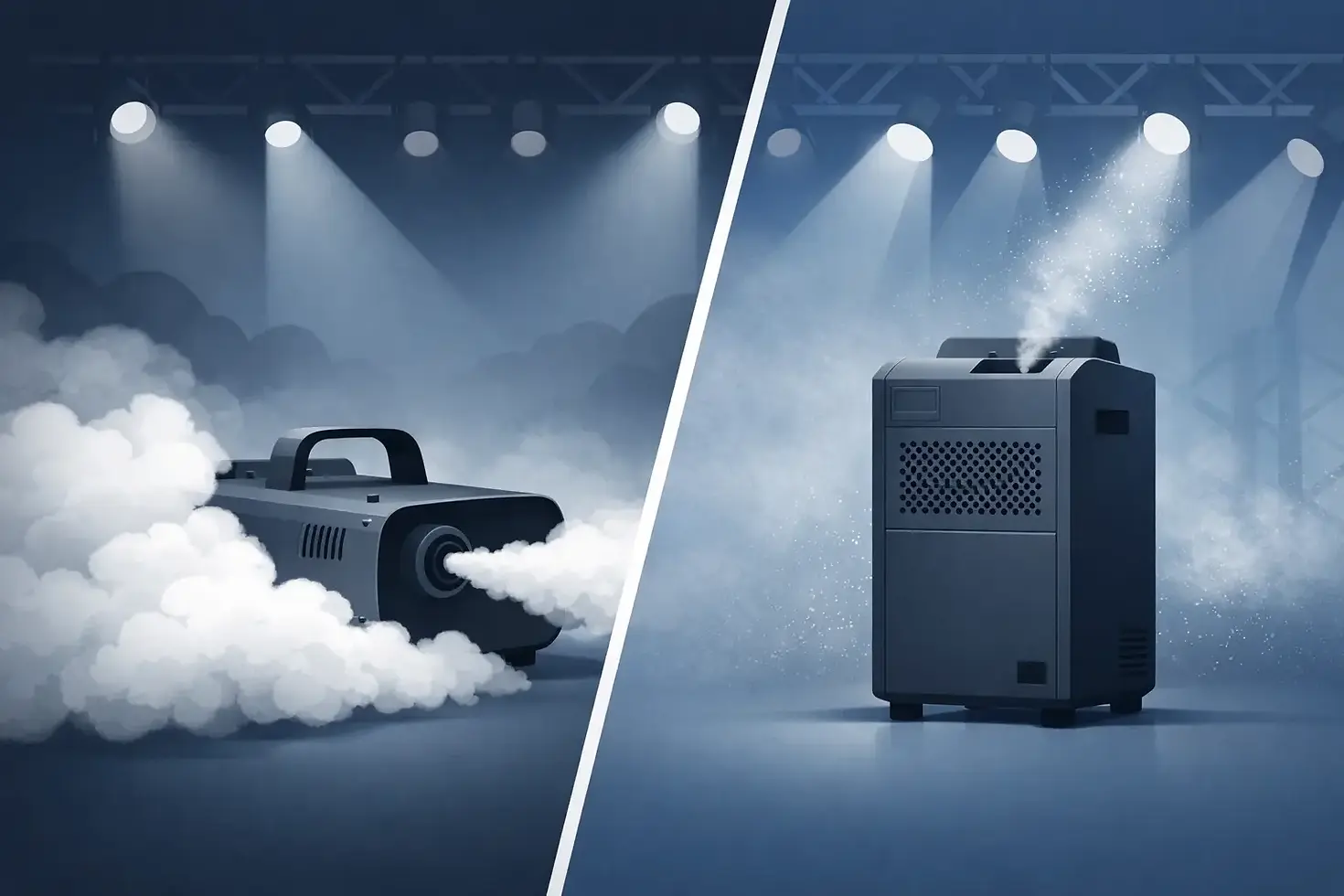
Fog Machines vs Haze Machines
A stage can look flat until the beams show up. A set can feel clean but lifeless until the air has shape. That is where the choice in fog machines vs haze machines starts to matter - not as a gear question, but as a creative and operational one.
Production teams often use the terms interchangeably, then find out on the day that they are solving two different problems. Fog gives you visible volume. Haze gives you atmosphere and light definition. If you pick the wrong one, the scene can read heavy when you wanted subtle, or disappear on camera when you needed texture.
Fog machines vs haze machines: the real difference
The short version is simple. A fog machine produces a thicker, denser cloud that reads as an obvious effect. A haze machine produces a much finer particulate spread that hangs in the air and reveals light beams without calling attention to itself.
That difference changes everything on set or in a venue. Fog is designed to be seen. Haze is designed to support what is already there - lighting, depth, mood, and separation.
In practical terms, fog usually rolls in as a cue, a hit, or a localized effect. Haze is more often treated like an environmental condition. One is a moment. The other is a layer.
When fog is the right call
Fog works when you want the atmosphere to be part of the action. Think low-lying cemetery drift, industrial steam, a reveal in a music video, a nightclub burst timed to a drop, or a horror setup where the effect needs to read immediately to camera.
Because it is denser, fog gives you shape fast. It can fill a frame, create movement, and add visible texture in a way haze cannot. That makes it useful for hero moments, entrances, transitions, and sequences where the effect needs to announce itself.
The trade-off is control. Fog can dissipate unevenly, travel in unwanted directions, and build up too aggressively in enclosed areas. Airflow from HVAC, practical fans, open doors, and even crew movement can change the look in minutes. On camera, that can be useful if you want motion. It can also be a problem if continuity matters across multiple takes.
Low fog is its own category. If the brief is a ground-hugging effect rather than a floating cloud, the machine choice, fluid choice, ambient temperature, and delivery method all matter. You do not get convincing low fog just by pointing a standard fogger at the floor and hoping for the best.
When haze is the better tool
Haze is usually the answer when the goal is to make lighting work harder. If you want to see shafts from moving heads, create depth in a concert rig, add separation in a commercial beauty setup, or keep a stage from feeling visually dead, haze is often the cleaner solution.
The best haze sits in the room without looking like an effect by itself. It gives the camera something to read between foreground and background. It helps beams, edges, and practicals carry. In live events, it can make a lighting design feel finished. In film and television, it can add mood without making the scene look like a smoke gag.
Haze also tends to be more consistent over time when the space and ventilation are managed correctly. That matters for long shooting days, live cueing, and any setup where you need the air to stay in a controlled range instead of spiking dense and then clearing out.
The limitation is that haze is subtle. If the creative brief calls for thick atmosphere, obvious drift, or a bold reveal, haze will likely underdeliver. It is a support player, not the star.
What camera and lighting do to the decision
This is where many choices get made. The same room can look completely different depending on lensing, backlight, exposure, color contrast, and fixture intensity.
Dense fog can look dramatic to the eye and muddy on camera. It can flatten contrast, obscure faces, and eat detail if the level is pushed too far. Haze usually gives you more finesse. It lets beams register while preserving the scene. But if the lighting package is weak or the room is too large, the haze may barely read.
Backlight changes the game. A light fog pass with strong backlight can read heavier than expected. A moderate haze level under carefully placed directional fixtures can look cinematic without ever drawing attention to the machine that created it. That is why effect planning cannot be separated from lighting and camera planning.
On live shows, the same principle applies. If the goal is visible aerial effects from lighting, haze often carries the load better across the run of show. If the cue is meant to hit with impact at a specific musical beat or entrance, fog may be the stronger choice.
Fog machines vs haze machines on set and in venues
The best choice depends on the environment as much as the visual goal. A soundstage behaves differently than a practical location. A theater behaves differently than an outdoor event. Ceiling height, ventilation, fire system sensitivity, audience proximity, and reset speed all affect what will actually work.
On controlled stages, haze can be maintained with more consistency if the HVAC plan is understood and the effect is monitored. On practical locations, especially large or drafty ones, maintaining haze can become a constant fight. In those spaces, a targeted fog effect may be easier to execute if the look only needs to appear for a specific beat.
Venues add their own constraints. Audience comfort matters. So do local rules, fire watch requirements, detector coordination, and line-of-sight issues. In some event environments, too much density will create operational problems long before it creates a better visual.
Outdoor work is another reality check. Wind will humble both fog and haze quickly. Haze often disperses too fast to be useful outdoors unless conditions are favorable and the coverage area is limited. Fog can read better in short windows, but it still needs planning, timing, and realistic expectations.
Safety, permits, and operational control
Atmospheric effects are not just aesthetic tools. They are part of the working environment. That means the decision between fog and haze should always include safety, ventilation, performer exposure, detector management, and the practical needs of the crew.
The right machine with the wrong fluid, the wrong placement, or no airflow plan can create unnecessary problems. Visibility can drop. Sensitive alarm systems can trigger. Talent comfort can change over a long day. Dance floors, stages, and set surfaces may need attention depending on the effect and environment.
That is why experienced effects support matters. In production, the machine is only one part of the job. Distribution, density control, cue timing, continuity, and coordination with other departments are what make the effect usable. On demanding shows, that is the difference between atmosphere that helps the image and atmosphere that slows the day down.
How to choose without wasting time
If you need the air to look thick, moving, and obvious, start with fog. If you need to reveal beams, add depth, and keep the effect mostly invisible, start with haze.
Then pressure-test that first choice against the real conditions. How big is the space? How much air movement is there? Are you shooting multiple takes for continuity? Is this a cue or an all-day environment? Are there detectors, audience considerations, or venue restrictions? Do you want the atmosphere to be seen, or do you want to see what the lighting is doing inside it?
Most bad outcomes come from treating fog and haze like interchangeable rentals instead of effect systems. The machine type matters, but so do placement, output rate, warm-up behavior, fluid type, fan support, and the crew running it. For production teams moving fast, that is where a specialist earns their keep.
At 2nd Unit Solutions, we approach atmospheric effects the same way we approach every practical effect - by matching the visual goal to the real-world conditions, then executing it safely and repeatably.
If you are deciding between fog and haze, the cleanest answer is this: pick the effect that serves the shot, not the label on the machine. The air should work for the image, the audience, and the schedule at the same time.


Comments