
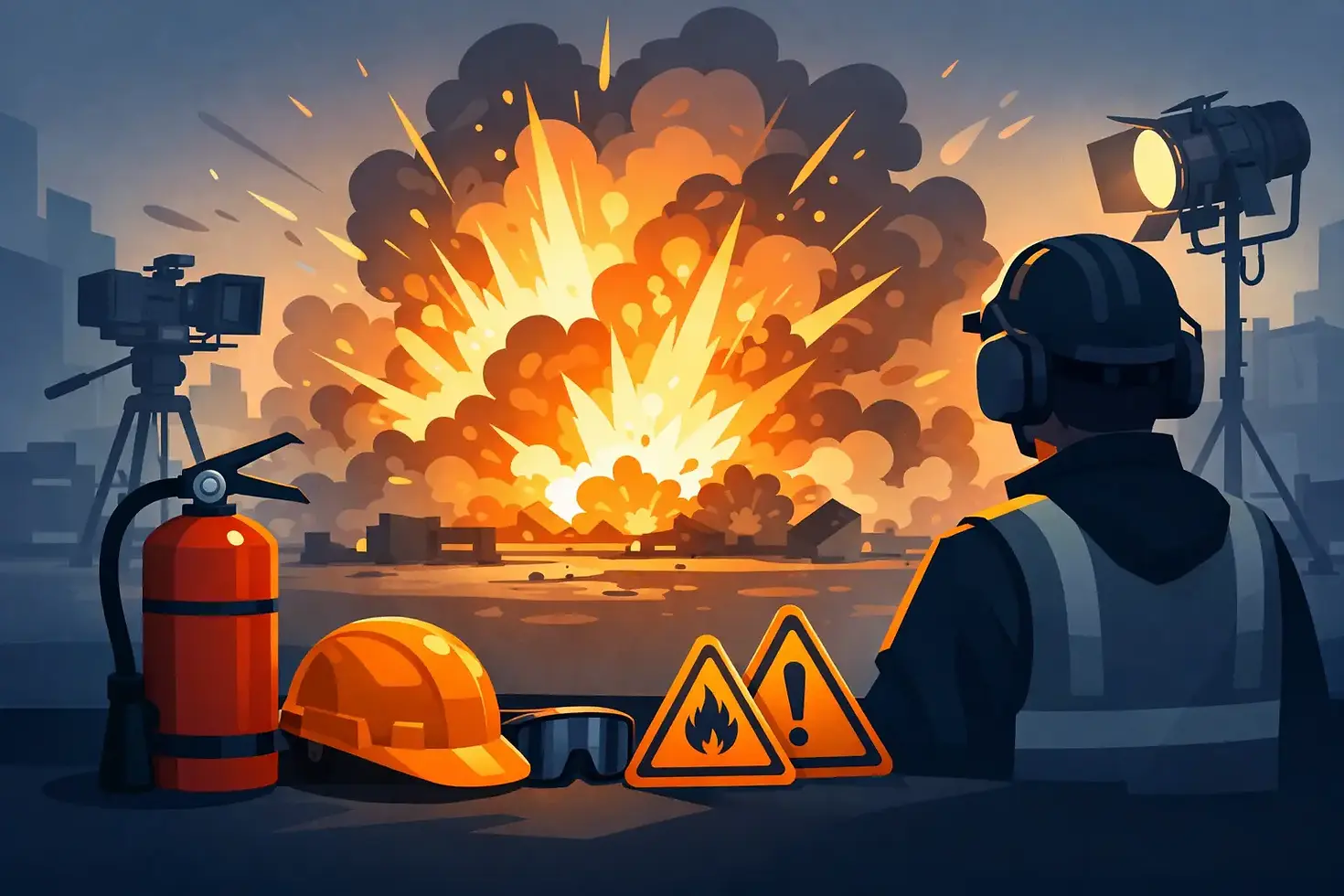
On Set Pyrotechnic Safety Requirements
A good pyro cue lasts seconds. The planning behind it starts days or weeks earlier, and that gap is where most on set pyrotechnic safety requirements live. If production treats pyrotechnics like a last-minute add-on, the risk goes up fast - not just for cast and crew, but for schedule, location access, insurance, and the shot itself.
Pyrotechnics on a set or live event floor are never just a creative decision. They are a controlled hazardous operation with legal, technical, and procedural demands that have to be built into the production plan. The safest effects teams know that compliance is only the baseline. Real safety comes from disciplined prep, clear authority, and enough time to say no when conditions are wrong.
What on set pyrotechnic safety requirements actually cover
At the production level, on set pyrotechnic safety requirements usually fall into five areas: licensing and permits, effect design, site conditions, crew communication, and emergency readiness. Each one affects the others.
A legally approved effect can still be unsafe if the set changes after the site survey. A well-designed cue can still fail if departments are not locked on timing, exclusion zones, and reset procedures. That is why experienced productions bring the special effects team in early. Pyro is not something to bolt onto the call sheet after locations, stunts, wardrobe, and camera have already made assumptions about space.
The specific requirements vary by jurisdiction, venue type, and effect type. A flash pot on an exterior backlot has a different approval path than a flame bar in a stage build or concussion effect near picture vehicles. Film and television productions also face a different operating environment than concerts or private events because camera placement, repeated takes, actor proximity, and hidden rigging can change the hazard profile.
Licensing, permits, and who has authority
The first requirement is simple: pyrotechnics must be handled by properly licensed professionals working under the rules of the local authority having jurisdiction. In Los Angeles and other major production markets, that often means fire department permits, site inspections, and documentation tied to a named licensed operator or special effects lead.
Production should not assume that a general event permit or location approval covers pyro. It usually does not. Separate approvals may be required for storage, transport, discharge, flame effects, indoor use, and standby fire safety personnel. The permit process also affects schedule. If a location changes, if the effect size changes, or if the product being used changes, the approval may need to be updated.
Authority on the day matters just as much as paperwork. One qualified person needs clear operational control of the effect. That person should have the power to delay or cancel the cue if safety conditions are not met. When authority gets diluted between ADs, creative leadership, venue staff, and department heads, bad calls happen. The crew needs to know exactly who is calling the effect live, who is confirming the area is clear, and who can stop it.
Site conditions are part of the safety requirement
Pyro safety is heavily dependent on the environment. Indoor versus outdoor is obvious, but there are more variables than that. Ceiling height, sprinkler systems, HVAC flow, nearby combustibles, weather shifts, terrain, audience lines, camera shielding, and egress routes all affect what can be fired and where.
Wind is a common example. A cue that is acceptable during prep can become a no-go an hour later if wind direction shifts toward cast, soft goods, dry vegetation, drapes, tents, or parked vehicles. The same goes for heat buildup, smoke accumulation, and debris travel. If production wants the shot at all costs, the effects team still has to work from actual conditions, not the original plan.
Distances are another major factor. Minimum separation from cast, crew, set walls, drapery, fuel sources, and public areas is not guesswork. It is based on the effect type, product specifications, test results, and local code requirements. If wardrobe changes to a more flammable fabric, if the camera moves closer, or if the actor has to hit a new mark, the safety plan may need to change with it.
Effect design, testing, and realistic creative decisions
Safe pyrotechnics start with effect design that matches the location, camera goal, and performer tolerance. That sounds obvious, but productions still get into trouble when they ask for a larger visual than the environment can safely support.
A smart special effects team will often scale the effect to what the space can handle and what the lens will actually see. Bigger is not always better. In many cases, a smaller, cleaner cue photographed correctly is safer and more effective than a large blast that introduces debris, noise load, heat, or reset complications.
Testing is a core requirement, not a luxury. Bench tests, product confirmation, and where possible a full-scale or representative field test help verify burn behavior, concussion level, spark spread, smoke output, and residue. Testing also gives other departments real information. Camera can judge exposure and shutter behavior. Sound can prepare for report levels. Wardrobe, hair, makeup, and stunts can evaluate talent impact. That kind of coordination prevents surprises when the effect goes live.
There is always a trade-off between speed and certainty. Productions under time pressure sometimes want to skip tests and go straight to shooting. That may save an hour now and cost the rest of the day later if the cue performs differently than expected or damages the set.
Crew communication is a safety control
Many pyro incidents start as communication failures, not technical failures. The device may function exactly as intended, but the people around it do not.
Every department affected by the cue needs a direct briefing in plain language. That includes where the effect is, what it does, where the fallout or pressure goes, what the hot zone is, what PPE is required, and what the command sequence will be. Crew members should not be left to infer risk from a vague note on the call sheet.
The lockup procedure matters. Before firing, the relevant areas need to be checked and confirmed clear. Nonessential crew should be out of the zone. Background performers need specific direction, not just a general warning. If there are minors, animals, picture vehicles, practical fuel systems, or hidden crew positions involved, the briefing needs to account for that. One missed person in the wrong blind spot is all it takes to create a serious problem.
The firing sequence should be standardized and audible to everyone who needs it. Rehearsal without live product is often worth the time, especially when pyro is tied to stunts, camera movement, music playback, or performer action. Complex cues fail when people are hearing the plan for the first time at the moment of ignition.
Fire protection, medical readiness, and shutdown criteria
On set pyrotechnic safety requirements do not end at ignition. Productions need fire suppression measures, emergency access, and a credible response plan for misfires, spot fires, injuries, and partial burns.
The right extinguishing equipment depends on the effect and the environment. Water, extinguishers, fire blankets, and dedicated fire watch personnel may all be part of the setup. What matters is that the protection matches the hazard and is in place before the rig goes live, not fetched after a problem starts.
Medical planning also needs to be proportional to the effect. A small controlled flash is not the same as a high-impact cue with nearby performers and debris potential. Some setups justify more advanced standby support, especially when multiple risk factors stack up.
Just as important are shutdown criteria. The team should know in advance what conditions stop the effect. That might be wind, loss of communication, a performer concern, a failed continuity check, encroachment into the exclusion zone, or a change in set dressing that introduces new combustibles. If production has no agreed stop points, pressure tends to push bad decisions through.
The documentation side of on set pyrotechnic safety requirements
Good paperwork does not make an effect safe by itself, but bad paperwork is often a sign that the operation is not under control. At minimum, productions should expect permits, product information, risk assessments or safety plans, site diagrams, crew brief documentation, and incident procedures appropriate to the job.
For larger shoots or live events, documentation also helps protect the schedule. When insurers, fire marshals, studios, venues, or producers ask for confirmation, the answers need to be ready. Delays often happen because safety planning exists only in verbal conversations.
This is where an experienced partner earns their keep. A team that handles pyro regularly can align compliance, logistics, and creative intent without treating them as separate tracks. That is how you avoid the last-minute scramble that turns a manageable cue into a production problem.
2nd Unit Solutions approaches pyro the same way it approaches every practical effect - with the crew, permits, planning, and field discipline to execute demanding work safely.
Pyrotechnics can absolutely be done well under pressure, but not by cutting the steps that keep people protected. If a cue matters enough to be in the shot, it matters enough to prep correctly, test honestly, and hold the line when conditions are off.


Comments