
Choosing a Pyrotechnics Vendor for Production
Updated: Jun 27
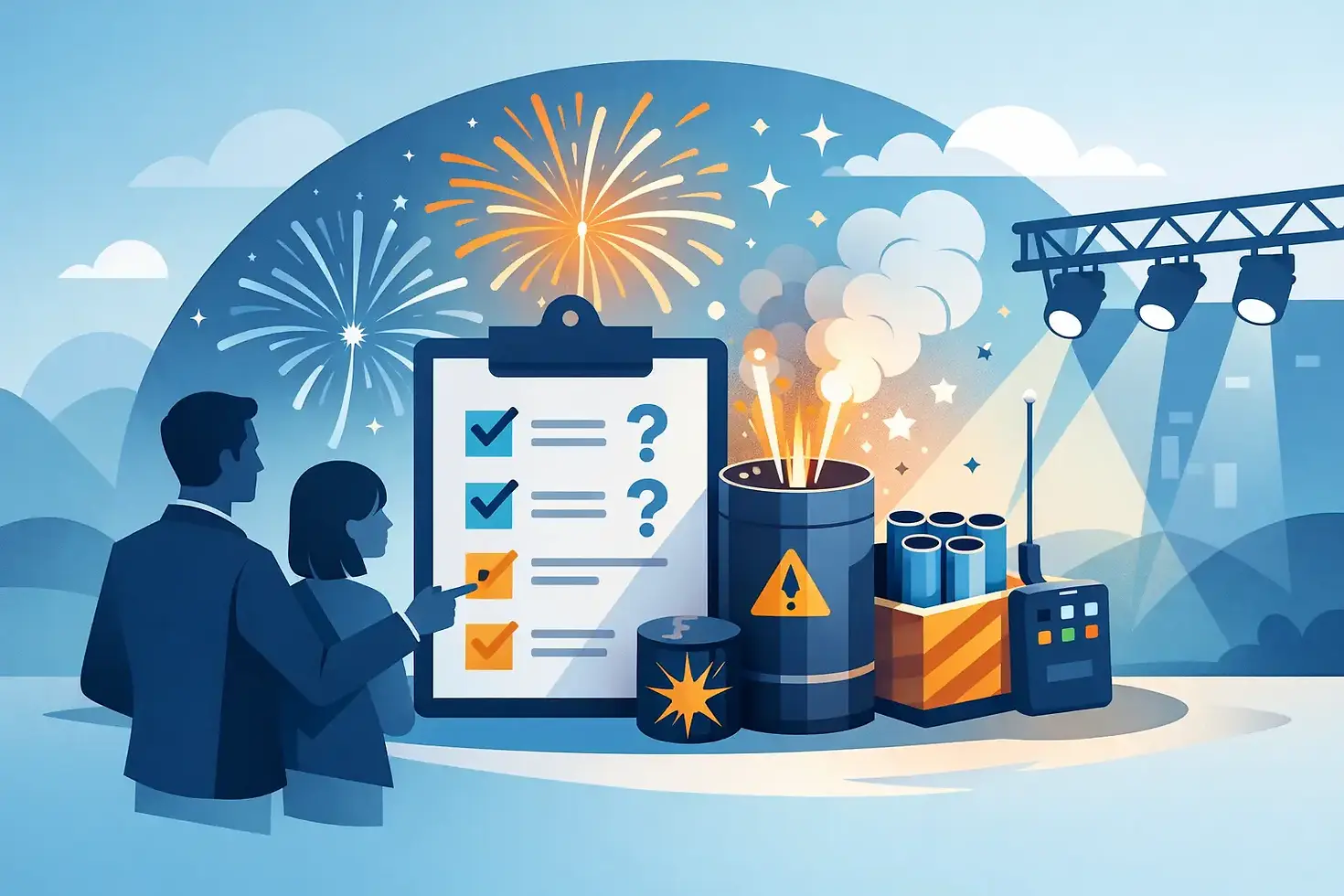
A fire gag that looks simple on a call sheet can turn into a permit problem, a schedule problem, or a safety problem fast. That is why choosing a pyrotechnics vendor is less about finding someone who can make a big effect and more about finding a partner who can execute the right effect under real production conditions.
For producers, production managers, directors, and event leads, the wrong hire usually shows up before the first cue. Paperwork is late. Questions about jurisdiction get vague. The vendor talks about spectacle but not fall zones, fire watch, or reset time. On a tight set or a live event, that is not a small issue. It affects insurance, approvals, crew confidence, and whether the day stays on track.
What choosing a pyrotechnics vendor actually involves
At the production level, pyrotechnics is never just a single service. It sits at the intersection of creative intent, engineering, local regulation, scheduling, and risk management. A good vendor understands all five.
That means your evaluation should go beyond demo footage or a gear list. A vendor may have impressive visuals in a reel, but if they cannot translate a concept into a practical plan for your location, your crew size, your shooting schedule, and your safety requirements, they are not ready for your job.
The best vendors tend to speak in production terms. They ask about ceiling height, setback distances, fuel loads, camera placement, ventilation, weather, audience proximity, and who has final authority to call a hold. They are not trying to slow the job down. They are showing they know where jobs fail.
Start with licensing and jurisdiction
This is the first filter because it is the easiest place to lose time. Pyrotechnic work is highly regulated, and the specifics shift by city, county, state, venue type, and whether the effect is for film, television, live entertainment, or a private event.
A qualified vendor should be able to explain what licenses they hold and how permitting works for your specific jurisdiction. They should also be clear about what they can self-manage and where outside approvals are required. If the answers are broad or evasive, keep looking.
In Los Angeles and other major production markets, experience with local authorities matters. Two vendors may both be licensed, but one may understand exactly how to prepare paperwork, schedule inspections, coordinate with fire officials, and build realistic timelines. That difference can save a production day.
Safety culture is not a sales line
Anyone can say safety comes first. What you need is evidence that safety is built into how they prep, crew, communicate, and execute.
Ask how they build a show or on-set plan. Ask who conducts safety briefings, who has stop-work authority, how exclusion zones are marked, and how misfires or weather changes are handled. Ask what their reset protocol looks like and how they coordinate with other departments, especially camera, stunts, grip, electrical, and AD staff.
A strong pyrotechnics vendor will not treat those questions as administrative. They will treat them as part of the job. That is usually a good sign that they understand pyrotechnics as a controlled technical discipline, not a highlight-reel service.
It also helps to look at how the vendor talks about limitations. Experienced teams are comfortable saying no, scaling an effect down, or suggesting an alternate method when a concept creates unnecessary risk. That is not a lack of capability. It is judgment.
Evaluate production fit, not just effect size
One of the most common mistakes in choosing a pyrotechnics vendor is assuming that bigger credits always mean better fit. Large-scale experience matters, but the right vendor for a stadium concert is not automatically the right vendor for a dialogue-heavy interior scene, a music video with a compressed schedule, or a private event with strict venue controls.
Fit comes down to whether the vendor can work inside your production realities. Can they scale crew appropriately? Can they coordinate with a lean commercial team as effectively as with a large studio crew? Can they deliver repeatable cues for multiple takes? Do they understand the pace difference between a live countdown moment and a narrative set with performance variables?
A vendor who is overbuilt for the job can create friction just as easily as one who is underprepared. You want a team that can match complexity to need without creating unnecessary overhead.
Ask how they handle design, prep, and execution
A capable pyrotechnics vendor should be able to walk you through the full process from concept to strike. That includes effect design, material selection, site assessment, permitting support, testing if needed, on-site setup, cue execution, fire safety coordination, and cleanup.
This matters because many production issues start in the handoff between planning and execution. If the vendor designs an effect one way but crews it another way on the day, reliability drops. If prep assumptions do not match the real location, timing slips. If cleanup and reset are treated as afterthoughts, the schedule pays for it.
When you talk with vendors, pay attention to how concrete they are. Do they discuss burn duration, debris, smoke behavior, sound levels, residue, and ventilation needs? Do they explain what is practical for the lens, not just what is possible in theory? The more specific the conversation, the better the odds they have done this at a professional level.
Crew depth matters when the schedule gets tight
A pyrotechnics vendor is only as strong as the team that shows up. On a straightforward cue, a small team may be enough. On a demanding set or event, crew depth becomes critical.
You need to know whether the vendor can staff licensed personnel appropriately, support simultaneous tasks, and maintain control during resets, holds, and last-minute creative changes. This is especially important when pyrotechnics overlaps with fire bars, flame effects, atmospherics, rain, wind, or custom-fabricated rigs.
A deep crew does more than move faster. It protects consistency. The same effect has to perform safely on the first cue and the fifth cue, whether conditions are ideal or not. That usually comes from trained technicians, not improvisation.
Choosing a pyrotechnics vendor for film, TV, and live events
The right questions change slightly depending on the format.
For film and television, repeatability is often the key issue. Can the effect be tuned for multiple takes, different frame rates, and camera angles? Can the vendor work cleanly around dialogue, continuity, and department coordination? Screen impact matters, but so does control.
For live events, timing and audience safety take the lead. Cue reliability, venue rules, fallout zones, weather exposure, and emergency planning all become more visible. A live event team needs to think in real time, with no second take.
For private events and branded productions, aesthetics and control often need to coexist with tight venue restrictions. In those settings, a vendor who understands how to achieve impact within narrow operational limits is usually more valuable than one who only pitches the biggest possible look.
Look for clear communication under pressure
Production does not reward vague communication. If a vendor is hard to pin down before the job, they will not get easier once permits, tech scouts, and cue changes start stacking up.
Strong vendors are direct. They answer what is feasible, what is not, what needs approval, what affects cost, and what affects schedule. They do not oversell. They do not hide behind jargon. They make it easier for production to make decisions quickly.
That crew-friendly approach is often what separates a technically qualified vendor from a genuinely reliable one. In this business, competence matters, but so does how well a team functions under pressure with the rest of the production.
A company like 2nd Unit Solutions is built around that reality. The job is not just to create the effect. The job is to deliver it safely, legally, and on time, with a crew that understands how production actually moves.
The best choice is usually the clearest one
When you are comparing vendors, the strongest option is rarely the one making the biggest promises. It is usually the team that gives you the clearest plan, the most credible safety structure, and the most realistic understanding of your production environment.
If they know the jurisdiction, speak plainly about risk, crew appropriately, and design effects around the real demands of your set or event, you are in the right conversation. Fire gets attention. Control is what makes it usable.


Comments