
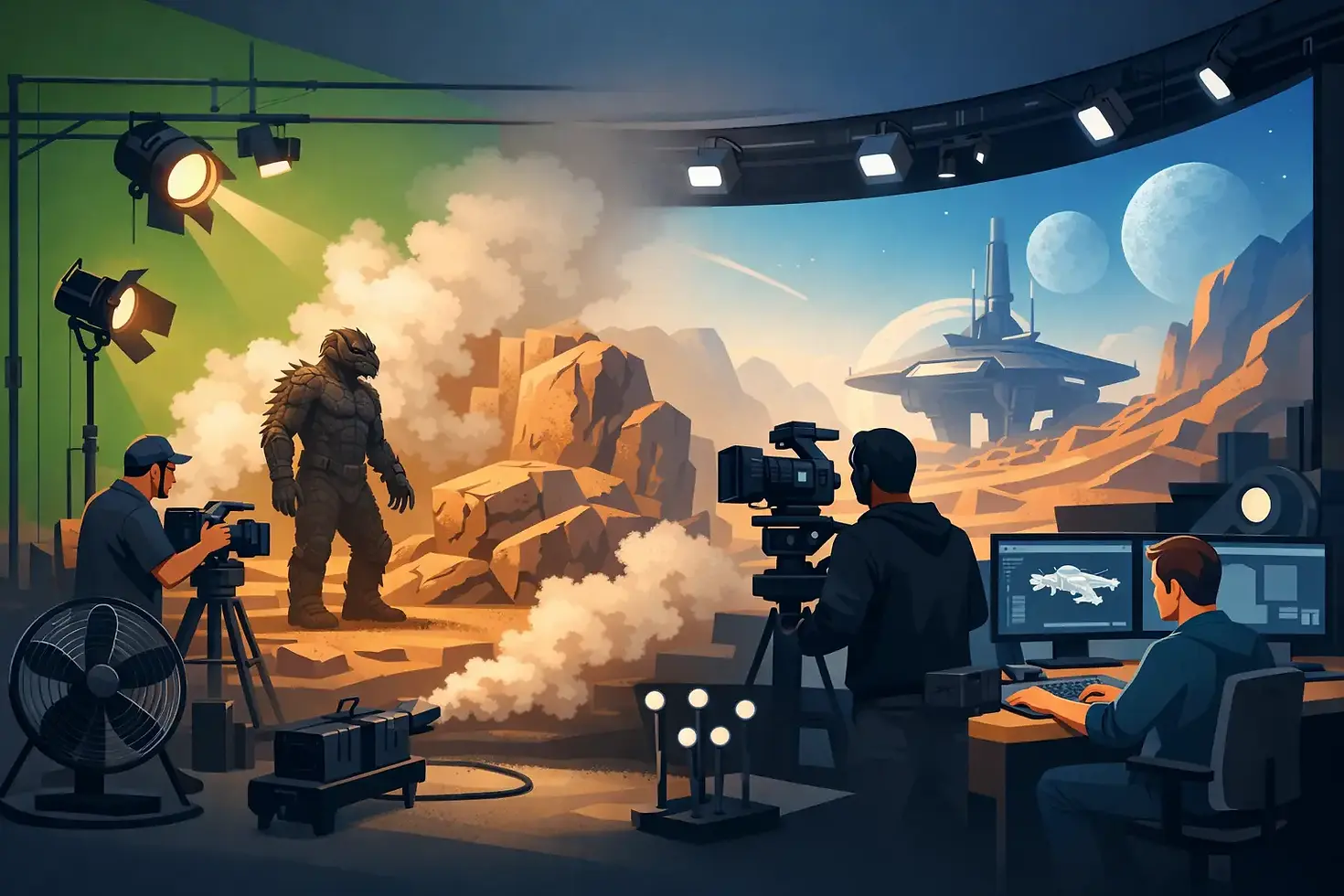
Virtual Production Practical Effects That Hold Up
An LED wall can place a cast member on a windswept ridge, inside a moving train, or beneath a neon city sky. But the frame still needs to feel physical. Virtual production practical effects provide the moving air, reflected light, drifting atmosphere, wet pavement, and interactive details that give a volume shoot real-world weight.
For production teams, the point is not to add effects for their own sake. It is to make the in-camera image believable, reduce the burden on post, and give performers something real to respond to. The work succeeds when the effect is planned as part of the shot, not brought in after the virtual environment is already locked.
What Practical Effects Add to a Virtual Set
Virtual production solves a major problem: it puts an environment, background lighting, and parallax into the camera at the time of photography. It does not automatically create the physical behavior of that environment around the cast and set pieces.
If the plate shows a storm, the actor's wardrobe, hair, props, and the foreground need to acknowledge that storm. If a vehicle is moving through a tunnel, the timing of wind, vibration, haze, and passing light has to support the image on the wall. If the scene takes place after rain, the floor needs the right sheen and controlled water behavior to catch the wall's color and practical lighting.
These details are often what separate a convincing virtual location from a clean stage with a background screen. Cameras read texture, depth, reflections, and motion quickly. Audiences may not identify the missing element, but they can feel when the foreground and background are operating under different conditions.
The most useful effects are usually the ones that connect the two worlds. A low fog layer can carry the color of an LED cityscape into the foreground. A controlled rain effect can create highlights that match a virtual street. Wind can move fabric and hair at the same direction and intensity suggested by the environment. Firelight, interactive flicker, and atmospheric haze can give faces and production design the variation that a flat lighting plan may not provide.
Virtual Production Practical Effects Start With the Shot
The first question is not, "What effect looks cool?" It is, "What must happen in frame for this shot to sell?" That question should be answered with the director, cinematographer, production designer, virtual art department, VFX supervisor, and special effects team in the same planning conversation.
A virtual desert sequence may need only a small amount of directional wind and dust around a foreground vehicle. A nightclub scene may need controlled haze so beams read in the room, plus practical reflections on the bar and floor. A storm sequence may need rain only in a narrow playing area, while the surrounding stage stays protected for equipment, crew movement, and resets.
That distinction matters because volume stages have real constraints. LED panels, tracking systems, camera equipment, power distribution, audio, and sensitive electronics all affect where and how an effect can run. A practical effect team needs the shooting plan early enough to design containment, drainage, airflow, safety zones, and reset procedures around the actual stage layout.
A good effects plan also accounts for lens choice and camera position. Rain that looks full at a long focal length can look sparse on a wide lens. Fog density that works in a moody medium shot can obscure a background or soften contrast when the camera moves. Wind that is appropriate for a close-up may become unconvincing in a wider frame where trees, flags, or loose set dressing should also react.
Effects That Usually Earn Their Place
Atmosphere is one of the most common tools in a volume because it adds depth between the camera and the wall. Haze can reveal light shafts, soften the transition between physical set pieces and the virtual horizon, and introduce natural variation into a controlled environment. It has to be managed carefully, especially where camera tracking, air circulation, alarms, and performer comfort are factors.
Wind is equally valuable because it gives the frame movement that cannot be faked by a background plate alone. The direction, pulse, and strength should match the virtual scene. A steady fan pointed at talent is rarely enough. The effect may need to hit a coat hem, vegetation, dust, curtains, paper debris, or a vehicle interior differently depending on the story beat.
Water effects demand the most coordination. Wet-downs, rain bars, rain towers, puddles, and spray all create reflections that can improve a virtual set substantially. They also create slip risks, drainage requirements, electrical considerations, costume continuity issues, and longer resets. In some cases, a targeted wet street foreground delivers more value than full rain. In others, the rain must be real because it is hitting talent, vehicles, or hero props in the shot.
Fire and pyrotechnics can bring immediate interactive light and physical stakes to a virtual environment, but they are not a casual add-on. Licensed personnel, permits, fire safety requirements, venue rules, ventilation, clearances, and emergency procedures must be addressed before the camera rolls. Sometimes a controlled flame effect is the right choice. Sometimes flicker lighting, smoke, debris, and a post element are safer and more efficient. The answer depends on the shot and the location.
Build for Control, Not Just Impact
The best practical effect is repeatable. A production may need six takes, a camera-side adjustment, a performance reset, and then a clean plate. If the effect cannot be reset with consistent timing and coverage, it can become the bottleneck that consumes the day.
That is why control systems, cueing, and testing matter. Effects should be tied to the shot's action: a wind gust begins on a door opening, rain increases as the actor steps into frame, or smoke enters only after a vehicle passes. The team should know who calls the cue, what happens on a hold, how the stage is cleared, and how continuity is maintained between takes.
Containment is just as important. Snow, dust, confetti, water, and fog all travel beyond their intended mark if they are not engineered for the stage. The practical solution may be physical masking, localized delivery, catch systems, adjusted fan placement, or a different effect method altogether. The goal is not maximum output. It is the exact result the camera needs with the least disruption to the crew and equipment.
Safety Is Part of the Creative Plan
Virtual production can make a controlled stage feel like an exterior location, but it does not remove the responsibilities of running effects around people and gear. It concentrates them. A small stage can quickly become crowded with operators, monitors, cable runs, set dressing, and video infrastructure.
Safety planning should cover equipment placement, wet-area boundaries, cable protection, ventilation, fire procedures, performer exposure, hearing considerations, and communication between departments. Effects work also needs to respect the operating limits of the volume. A solution that looks right for one take but puts LED panels, tracking accuracy, or crew access at risk is not a production-ready solution.
The strongest crews bring safety into the conversation before they arrive with equipment. At 2nd Unit Solutions, that means treating the stage plan, effect design, and execution plan as one job rather than separate handoffs. It keeps creative choices grounded in what can be delivered reliably under show conditions.
When to Use Practical Effects and When to Hold Back
Not every virtual scene needs a physical weather system. If rain is distant, out of focus, or only visible outside a window, a digital element may be the smarter choice. If a scene requires a massive dust storm but the camera is tight on a performer, localized wind and particulate movement may provide the needed interaction without filling the stage.
Practical effects are most valuable when they affect the foreground, the cast, the props, or the lighting in a way the camera will notice immediately. They are also valuable when they reduce roto, create usable reflections, or help the director evaluate the final image on set. The trade-off is time, cleanup, safety planning, and the need for physical control.
Start with the frame, identify the elements that need to be real, and test those elements before the schedule gets tight. That approach gives the virtual environment a physical response without turning the stage into a problem to manage.


Comments