
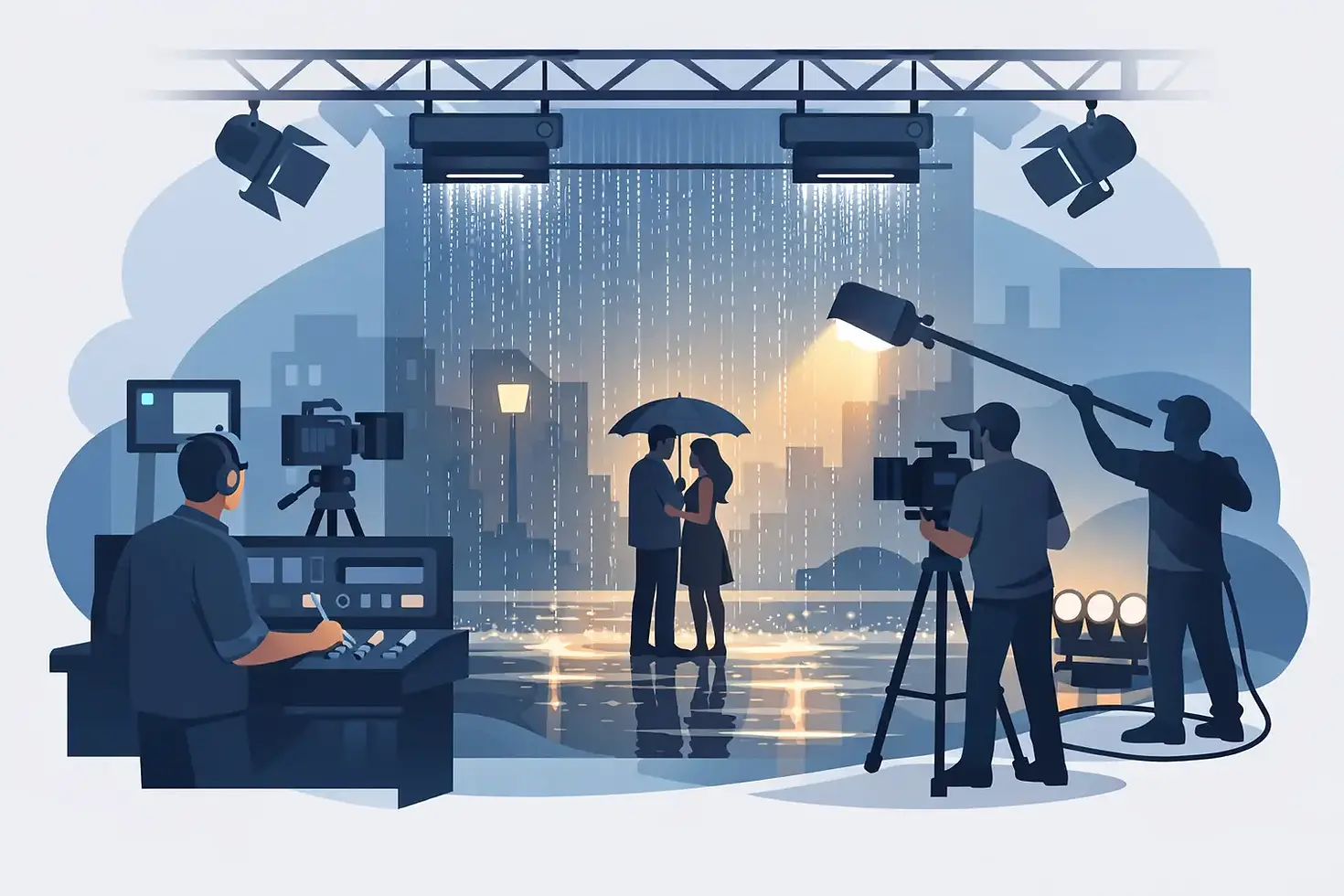
How to Create Controlled Rain Scenes
- Apr 25
- 6 min read
A rain scene usually looks simple on screen right up until production tries to shoot one fast, safely, and without wasting half the day chasing coverage problems. If you are figuring out how to create controlled rain scenes, the real job is not just making water fall. It is building a repeatable effect that reads on camera, protects cast and crew, and holds up across multiple setups.
That takes more than hoses and pressure. It takes planning, rigging, drainage, electrical coordination, wardrobe awareness, and a crew that knows how rain behaves once cameras roll.
How to create controlled rain scenes that actually read on camera
The first mistake productions make is thinking more water automatically means better rain. On camera, rain only works when it is visible in relation to light, background, lensing, and frame size. A heavy downpour with poor backlight can disappear. A lighter effect with the right angle and contrast can look far more dramatic.
Start with the shot, not the rig. Are you building a tight hero moment on talent, a wide exterior, a driving sequence, or a live event effect? Each one changes nozzle choice, rig height, pump requirements, and water volume. A close-up may need controlled streak size and precise lighting placement. A wide shot may need broad coverage and significantly more infrastructure to avoid dead zones.
Consistency matters just as much as intensity. If rain density changes from setup to setup, editorial will feel it immediately. Controlled rain is about repeatability. You want the same fall pattern, pressure, and coverage every take unless creative asks for a change.
Start with location, logistics, and water management
Before any rig goes up, the location has to support the effect. That means access to water supply, space for tanks or support equipment, drainage paths, power separation, and enough clearance to rig safely above frame. On a stage, the questions are different than on a street location. On location, you may be managing uneven surfaces, public access, runoff direction, and municipal restrictions.
Water management is where many rain scenes are won or lost. If water pools where talent needs to run, if sidewalks become slick, or if runoff enters the wrong area, the effect becomes a safety problem fast. Controlled rain scenes need a plan for where the water comes from, where it lands, and where it goes after each take.
That is also why prep with other departments is non-negotiable. Electric needs clear separation and protection. Grip needs to coordinate rigging and overhead support. Camera needs to understand splash zones and lens protection. Wardrobe and makeup need to know how wet talent will actually get, not how wet the director thinks they will get.
Building the rain rig
There is no single setup for how to create controlled rain scenes because the rig depends on scale and environment. But the principle stays the same: deliver even distribution over the playing area with enough pressure and height to create a natural fall pattern.
For many film and television applications, rain bars or custom pipe grids with selected nozzles are the starting point. Rig height changes the look. Too low, and the water can feel like a shower effect. Higher placements help produce a more believable vertical fall, but they also increase drift and demand stronger support and more precise control.
Nozzle choice matters. Different heads produce different droplet sizes and textures. Larger droplets often read better on camera, especially at night, but they can also soak wardrobe faster and create more splash off the ground. Finer spray may look wrong unless the shot and lighting support it. This is one of those areas where tests save time. What looks good to the eye may not read the same through the lens package being used that day.
Pressure and flow have to match the build. More pressure is not always better. If the spray atomizes too much, wind will push it off target and the effect starts to feel misty instead of cinematic. If pressure is too low, coverage gets patchy. A controlled rain effect should be tunable, especially when coverage changes from a two-shot to a wider moving frame.
Lighting is what makes rain visible
If the production is asking how to create controlled rain scenes, the answer is often lighting before water. Rain needs contrast to show up. The classic approach is backlight or side backlight, which catches the droplets and separates them from the background. Without that edge, even substantial rain can vanish.
Night rain is usually the easiest to sell because practicals, streetlights, headlights, and shaped backlight do a lot of the work. Day rain is more demanding. It often requires stronger water volume, careful framing, and enough background contrast to reveal the effect. Overcast conditions can help with mood but hurt visibility if the frame goes flat.
The background matters too. Rain crossing a dark tree line reads differently than rain against a bright sky or reflective building. Sometimes the best fix is not increasing water. It is adjusting the angle, changing the lens, or introducing shape into the lighting plan.
Wind, weather, and the problem of drift
Outdoor rain work is never just rain work. Wind changes everything. A slight crosswind can turn a clean vertical fall into diagonal streaks that miss the action area. That may be useful creatively, but it can also destroy continuity and waste reset time.
This is where practical effects planning has to stay flexible. You may need to shield the set, reduce spray height, adjust nozzle selection, or narrow the effect to protect the frame. In some cases, it is smarter to concentrate rain where camera sees it rather than trying to soak an entire block.
Real weather creates another trade-off. Natural rain can help with atmosphere, but it rarely gives production-level consistency. Controlled rain scenes exist because productions need cueable results. If the scene has to match over hours of coverage, the effect has to be something the crew can repeat.
Safety is part of the effect design
Rain scenes introduce slip hazards, visibility issues, electrical exposure risks, and cold stress for cast and crew. That is not separate from the creative plan. It is part of the creative plan.
Walking paths need traction. Cables need protection and routing discipline. Wet wardrobe on talent changes mobility and comfort, especially on long nights. If performers are doing stunts, running, fighting, or working near vehicles, rain intensity and ground conditions need to be designed around that action.
Temperature matters more than many productions expect. Even in Los Angeles, repeated wet resets can wear down performers and background quickly. Heated holding, dry replacements, towels, and a realistic reset schedule make a difference. A rain effect that looks great for one take but is unsustainable for six pages of coverage is not a controlled effect. It is a problem.
Working with camera, wardrobe, and sound
Rain scenes live or die in the handoff between departments. Camera needs a clear understanding of where rain starts and stops, which lenses are most vulnerable, and how splash will affect the foreground. There is no point building a wide rain field if the chosen framing only needs a controlled lane through the center.
Wardrobe needs advance notice because fabric choice completely changes the result. Some materials go transparent, cling in unflattering ways, or darken inconsistently across takes. Continuity becomes difficult if duplicate costumes are limited or dry-down times are ignored.
Sound is another reality check. Heavy rain rigs generate noise. If production is chasing clean dialogue, the effect may need to be shaped around that requirement, or the schedule may need to account for ADR. There is no perfect answer. It depends on the scene, the budget, and what matters most in the final cut.
Why experienced rain crews save time
The reason productions bring in a dedicated effects team is simple. Rain looks chaotic on screen, but getting it to behave is technical work. An experienced crew can scale the effect to the shot, troubleshoot weak coverage, coordinate with other departments, and keep safety standards in place while the schedule moves.
That is especially true on commercial shoots, music videos, and night exteriors where time pressure is high and every reset costs real money. The right practical effects partner will know when to widen the effect, when to localize it, when to adjust droplet size, and when the issue is not the rain at all but the lighting or frame.
At 2nd Unit Solutions, that is how we approach rain work: build for the shot, control the variables, and execute safely.
The best rain scenes are engineered, not improvised
When people ask how to create controlled rain scenes, they are usually asking how to make them look cinematic. The better question is how to make them work for production. Those are not always the same thing. The most dramatic setup on paper may be the wrong one if it creates continuity issues, slows the company move, or puts talent in avoidable risk.
Good rain work is precise. It matches the lens, the blocking, the set, the schedule, and the safety plan. When all of that is aligned, the effect stops feeling like an effect. It just feels like weather that happened exactly when the scene needed it.


Comments