
How to Stage Safe Practical Fire
The shot looks simple until flame is involved. A candle wall, a bar-top burn, a controlled ground hit, or a hero fire gag can go sideways fast if the plan starts with the visual instead of the safety framework. If you are figuring out how to stage safe practical fire, the real job is not just creating flame on cue. It is designing a controlled effect that performs predictably under production conditions.
For producers, directors, and event teams, that means bringing fire into the schedule early. Practical fire is never just an art department detail or a last-minute effects add-on. It affects permitting, crew positions, fuel choice, camera planning, HVAC behavior, fire watch, performer safety, and reset time. The productions that get it right usually treat fire as a technical system, not just a visual element.
How to stage safe practical fire starts with scope
Before anyone talks about flame height or color, define exactly what the effect needs to do. Is the fire decorative, atmospheric, interactive, or stunt-adjacent? Does it need to burn for ten seconds or two hours? Will talent be near it, pass through it, or physically handle anything heated? Those answers shape the entire approach.
A small tabletop flame for a locked-off insert is one category of problem. A live event fire effect in front of a crowd is another. A burn gag on a wind-exposed exterior adds a different set of variables. Safe execution depends on matching the effect design to the environment, not forcing a stock setup into a location that was never right for it.
This is also where budget and timeline become safety issues. If the effect requires custom rigs, shields, gas runs, nonflammable treatment, or extra fire personnel, that needs to be built into prep. Trying to compress those decisions into shoot day usually leads to compromises, and compromises around flame are rarely the smart kind.
The safest fire effect is the one you have engineered
Practical fire should be controlled at the source. That sounds obvious, but a surprising number of unsafe situations start when productions chase a look with improvised burners, unknown fuels, or scenic materials that were never tested together.
The better approach is engineering first. Fuel source, burner type, ignition method, kill method, containment, distance to combustibles, ceiling height, ventilation, and emergency access all need to be decided as a package. A good-looking flame that cannot be shut down instantly is not a good effect. A set piece that burns beautifully but heats adjacent materials beyond tolerance is not a finished design.
Different fuel systems carry different benefits and trade-offs. Gas-fed fire can offer consistency and repeatability, but it requires proper routing, regulation, and secure control. Liquid fuel can produce a different look, but it increases spill, absorption, and flash risk. Gelled products may help in some narrow applications, but they are not a shortcut around professional design. The right answer depends on the shot, the location, and the reset requirements.
Materials matter just as much. Scenic finishes, drapes, props, wardrobe, flooring, and nearby build elements can all change the risk profile. Fire-retardant treatment helps in some cases, but it is not universal protection and it does not make poor planning acceptable. Treated material can still fail under direct heat or extended exposure.
Permits, authorities, and venue rules are part of the effect
Any serious conversation about how to stage safe practical fire has to include permitting and authority having jurisdiction. In Los Angeles and most major production markets, practical flame work often requires advance coordination with fire officials, location representatives, studios, or venue operators. The effect cannot be separated from those approvals.
This is not paperwork for its own sake. Permit conditions often determine crew requirements, extinguishing equipment, inspection procedures, standby personnel, and allowable operating windows. On a stage, you may have one set of constraints. In a historic venue or public-facing event space, you may have another. Exterior work can introduce weather, brush clearance, and public safety perimeter issues.
The mistake productions make is assuming a modest flame effect will be treated casually. Sometimes the smallest open flame creates the biggest headache because it is placed in a sensitive environment, near egress paths, under low ceilings, or close to audience sightlines. If the venue says no open flame, there is no workaround by calling it decorative.
Rehearsal and crew communication prevent most problems
A practical fire setup should never debut during a take. It needs a dry rehearsal, a technical rehearsal, and clear verbal protocols. That includes who gives the fire cue, who confirms lockup, who has authority to abort, and who handles suppression if the effect behaves outside spec.
Departments need the same information, not different versions of it. Camera should know flame envelope and safe lensing distance. Grip and electric should know what gear cannot drift into the heat zone. Art should know what can and cannot remain in frame. Wardrobe and hair need to account for heat, airflow, and fiber behavior. AD, safety, and effects need one chain of command.
When talent is involved, the briefing should be direct and short. Hit marks, movement paths, hold points, exposure time, and stop actions need to be completely clear. If a performer seems unsure, that is not a morale issue. That is a signal to rehearse again or redesign the gag.
Distance, airflow, and heat load are where sets get surprised
Visible flame is only part of the hazard. Heat transfer and airflow are usually what catch productions off guard. A flame that looks modest on camera can create enough radiant heat to damage scenic elements, trip venue concerns, or make a performer’s position unsafe after multiple takes.
Air movement changes everything. HVAC systems, open bay doors, stage fans, exterior wind, and even crowd movement in event settings can alter flame shape and direction. That is why safe practical fire work depends on testing in actual conditions whenever possible, not just in a shop.
Clearance needs to be real, not estimated by eye. That includes vertical clearance, side clearance, and hidden surfaces behind scenic facades. If the effect is near overhead soft goods, decorative foliage, untreated wood, low foam pieces, or concealed wiring, the setup needs another look.
Fire watch, suppression, and shutdown are non-negotiable
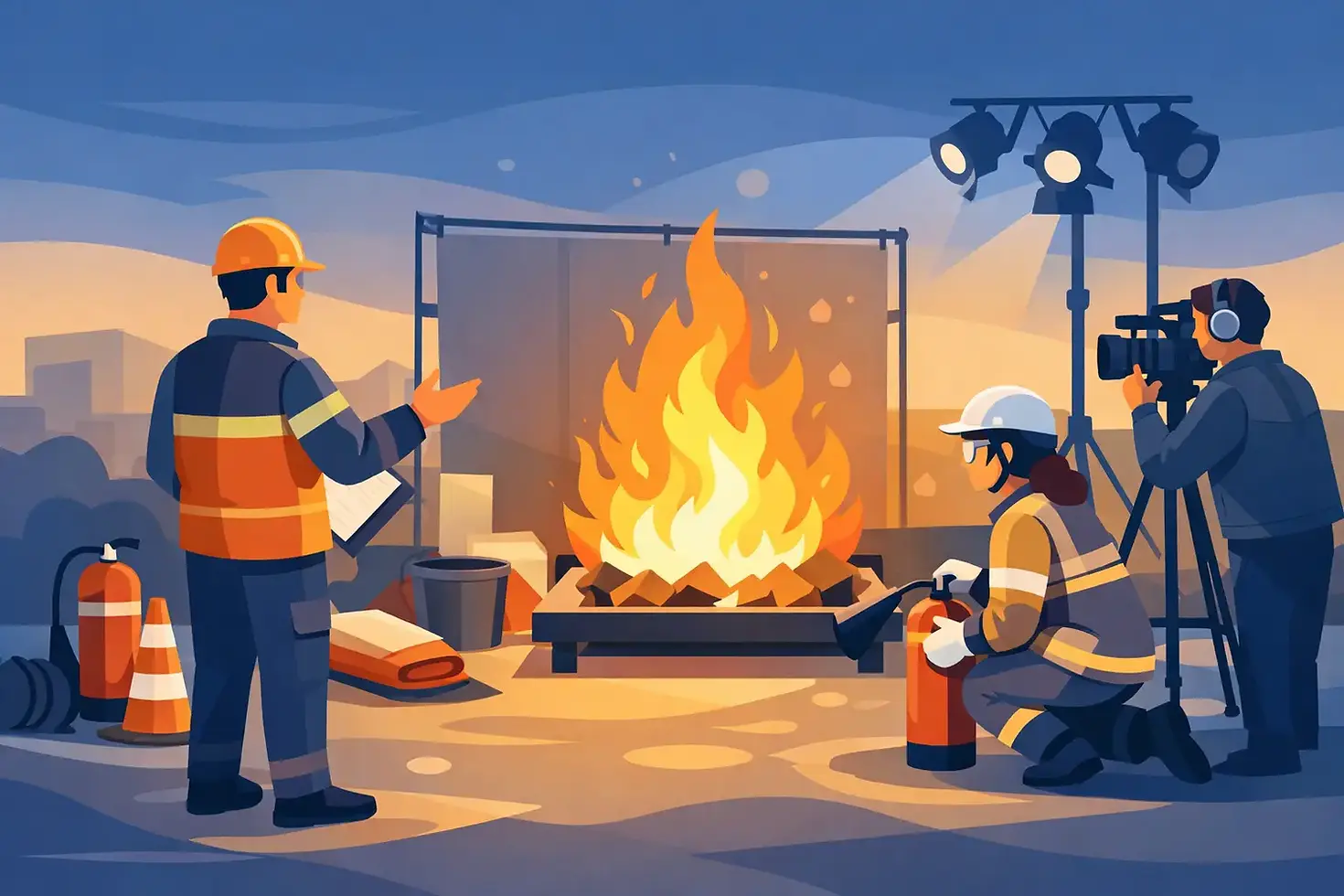
Every practical fire effect needs a suppression plan that matches the actual hazard. Not just a generic extinguisher nearby. The right extinguishing media, fire blankets if appropriate, emergency shutoff access, and personnel who know their assignment should all be in place before ignition.
Shutdown should be immediate and simple. If the primary operator loses access to controls, there should be a backup path. If the effect relies on manual intervention to stay safe, that has to be accounted for in staffing and blocking. A fire setup that is safe only when everything goes right is not production-ready.
Fire watch is also more than standing nearby and looking serious. It means monitoring adjacent materials, checking for latent heat after cut, verifying that no ember, spill, or hot component remains active, and confirming the set is safe before reset or company move. The end of the shot is often where people get casual. That is exactly when secondary ignition can happen.
How to stage safe practical fire when schedules are tight
Tight schedules do not change the physics. They only reduce your margin for error. If the day is heavy, the answer is not to trim prep, cut rehearsals, or skip authority coordination. The smarter move is scaling the effect to what can be safely controlled within the production window.
Sometimes that means reducing flame size and letting camera do the rest. Sometimes it means changing the angle, isolating the effect as a separate element, or redesigning the scenic environment to improve clearance and access. There is no loss of credibility in saying a larger gag needs more time, more protection, or a different location. That is professional judgment.
For that reason, experienced effects teams are valuable long before shoot day. They can flag whether the requested flame behavior is realistic, whether the venue can support it, and where the creative can be preserved without introducing unnecessary risk. That is usually the difference between a controlled fire effect and a preventable production problem.
A well-staged fire effect does not call attention to the safety work behind it. It just performs, resets, and stays inside the plan. If you are building practical flame into a film, broadcast, concert, or private event, treat safety as part of the effect design from the first conversation. That is how the shot gets done correctly, and how everyone is ready for the next one.


Comments